Taliban Detains 5 Women Protesters in Takhar
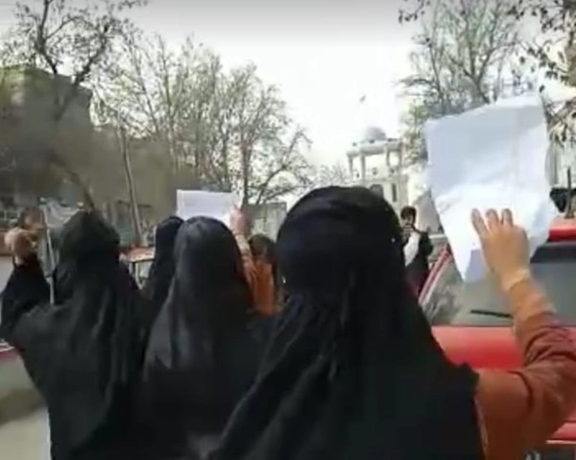
The Taliban have arbitrarily detained at least five women protesters and transferred them to an unknown location. Women protesters said that there are no other details about the identity of the detainees.

The Taliban have arbitrarily detained at least five women protesters and transferred them to an unknown location. Women protesters said that there are no other details about the identity of the detainees.
A group of women in Takhar province held a protest against the ban on education for women on Saturday.
At the same time, a large demonstration has been held by the student movement in Herat province. Taliban members in Herat also violently suppressed the women’s demonstration.
Taliban’s ban on the right to education for women in Afghanistan has caused widespread reactions in the past week.
Many male students at various universities in Afghanistan, in response to the Taliban ban, have declared that they are not ready to attend their classes until the Taliban leadership revokes the decree.
More than 60 university lecturers in Afghanistan have also resigned in response to the Taliban’s decision to ban education for girls.


Sources from Herat said that after the large-scale demonstration by women in Herat, the Taliban has increased its military presence in the city. According to these sources, Taliban fighters have swarmed city roads leading to Herat university and the governor’s office.
One of the girls who was a part of the demonstrators said that the increase in the presence of Taliban fighters in the city shows how much the group fears the people.
Meanwhile, male students of Herat University said that the Taliban has closed Herat University "until further notice".
Taliban officials have not reacted to the reports so far.
A resident of Herat said that a group of 15 people in uniform have been stationed at the gate of Herat University, dozens of Taliban forces are present at the Mostofiat roundabout and other Taliban members are present on the streets leading to the university and the governor's office to prevent any kind of gathering of women.
Herat Students' Movement on Saturday said that many male and female residents of Herat protested against the ban on education for girls and women.
In a video reviewed by Afghanistan International, it can be seen that the Taliban used fire trucks to disperse the protesters.
Members of the Herat Students’ Movement also said that the Taliban used whips, electric gears, and rifle shafts to beat up female students. In the pictures that they sent to Afghanistan International, bruises can be seen on the students' bodies.

Sources in Kabul said that several drones have been spotted over the capital city on Friday. According to residents, patrolling by the drones continued for several hours. No further information about the origin and mission of these drones has been revealed yet.
The Taliban has not reacted to these reports so far.
After the leader of al-Qaeda, Ayman al-Zawahiri had been killed in a US drone strike in Kabul earlier in 2022, the US Department of Defense announced that there are significant terrorist threats from Afghanistan.
Earlier, drones have been spotted in other provinces of Afghanistan too.

The US had committed to not targeting Taliban leaders as part of secret annexure of the Doha agreement, sources from Taliban and previous Afghan government, told Afghanistan International. The Agreement was signed on February 29, 2020, between the US and the Taliban in Qatar.
After the Taliban has returned to power in August 2021, the US has not carried out any attack against Taliban leaders in Afghanistan.
Several Taliban leaders have been on the list of international terrorists, and the United States has offered millions of dollars in bounty for providing information that leads to the arrest or killing of these people.
These leaders include the Taliban interior minister, Sirajuddin Haqqani; Taliban defense minister, Mullah Yaqoob; Taliban’s Minister of Public Works, and brother of the former leader, Mullah Mannan Niazi. These leaders had no media appearance, but soon after the group’s return to power in 2021, they have been the public faces of the group.
Even though the United States has no military footprints in Afghanistan, the country continues to carry on over-the-horizon missions across the country.
Under this mission, while the US has not targeted any Taliban leader, it has carried out operations against Islamic State-Khurasan (IS-K) and al-Qaeda members.
However, a Taliban security official told Afghanistan International on condition of anonymity that Washington had committed not to attack Taliban leaders.
A senior security official of the former government, who had regularly participated in senior security meetings of Ashraf Ghani’s government, too, confirmed the Doha secret annexures of not targeting Taliban leaders.
The source added that before the fall of Afghanistan to the Taliban, the Taliban’s current defense minister Mullah Yaqoob and foreign minister Amir Khan Muttaqi held public appearances and roamed freely in southern Afghanistan.
The former Afghan government at that time had detained a journalist for allegedly conducting an interview with Mullah Yaqoob and forced Shamshad TV not to air an interview with Muttaqi.

Anas Haqqani, a Taliban leader has indirectly expressed dissatisfaction with the current situation in Afghanistan. In his poem published after Taliban’s closure of universities for Afghan girls, Haqqani had allegedly conveyed that the group no longer believes in consultation.
The poem stated, “What can I say? There is nothing to say,”. Twitter users have responded to his verses and stated that he should not focus on poetry, rather he must act.
The dissatisfaction of Anas Haqqani, who is also the brother of Sirajuddin Haqqani, the interior minister of the Taliban and leader of the Haqqani Network, evident in the poem exposes the deep divisions between the Taliban leaders.
In one of the rhymes, Haqqani said, "Demanding and holding Jirga is no longer effective among Pashtuns, and there is no intention to accept [advice]."
It seems that the Haqqani Network which had been behind the bloodiest attacks against civilian targets in major cities of Afghanistan can no longer stand against the powerful traditional leadership of the Taliban from southern Afghanistan.

Just two days after the Taliban imposed a ban on higher education for girls, more than 60 university lecturers have protested and resigned from their positions. The lecturers have called their resignations a form of protest against the gender apartheid policy of the Taliban.
The wave of resignations of university lecturers began when the Taliban ordered banning girls from higher education in public and private universities across Afghanistan.
These university professors have individually resigned from their positions. but have mentioned clearly that they no longer continue to work in the higher education field in Afghanistan due to the Taliban’s ban on girls’ education.
They have also said that they are not ready to return to Afghanistan until the decree of the Taliban leader against girls’ higher education is revoked.
At the same time, a number of university professors have announced that they will not attend classes until the Taliban’s decision on banning girls’ education has been revoked.
Meanwhile, many students across Afghanistan have boycotted attending classes until female university students are allowed to return to their classes.